
HISTORY:
In 1978, work on a layered model of network architecture was started and the International Organization for Standardization (ISO) began to develop its OSI framework architecture. OSI has two major components: an abstract model of networking, called the Basic Reference Model or seven-layer model, and a set of specific protocols.
The concept of a 7 layer model was provided by the work of Charles Bachman, then of Honeywell. Various aspects of OSI design evolved from experiences with the ARPANET, the fledgling Internet, NPLNET, EIN, CYCLADES network and the work in IFIP WG6.1. The new design was documented in ISO 7498 and its various addenda. In this model, a networking system is divided into layers. Within each layer, one or more entities implement its functionality. Each entity interacts directly only with the layer immediately beneath it, and provides facilities for use by the layer above it.
Protocols enable an entity in one host to interact with a corresponding entity at the same layer in another host. Service definitions abstractly describe the functionality provided to an (N)-layer by an (N-1) layer, where N is one of the seven layers of protocols operating in the local host.

Description of OSI layers
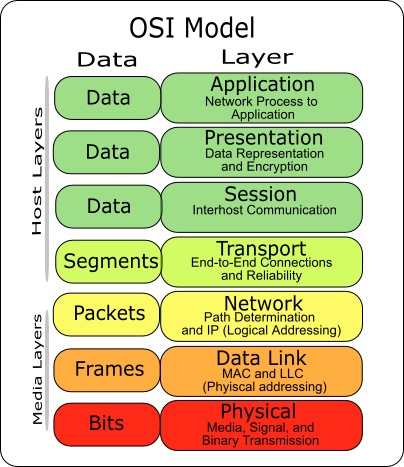
OSI / REFERENCE MODEL
The OSI reference model is an arbitrary hierarchical stratification (layering) of computer networking functions. The stratification consists of seven layers.There are various ways of implementing the protocols at any given layer. OSI is a CONCEPTUAL model.- Presentation Layer
- Session Layer
- Transport Layer
- Network Layer
- Data Link Layer
- Physical Layer
Physical Transmission Media The OSI Reference ModelLAYER 7 – The APPLICATION Layer The top layer of the OSI model  TCP/IPTransmission Control Protocol/Internet Protocol (TCP/IP) is a DoD developed, widely accepted and used communications protocol. TCP/IP has only four layers, which roughly correspond to groups of the OSI model. The Internet, many internal business networks and some home networks used TCP/IP.The four layers in TCI/IP are:
More information on the OSI layers are to be posted in future posts...
OSI / REFERENCE MODEL
The OSI reference model is an arbitrary hierarchical stratification (layering) of computer networking functions. The stratification consists of seven layers.
There are various ways of implementing the protocols at any given layer. OSI is a CONCEPTUAL model.
Protocols are prescriptive methods which delineate the communication that is to take place at a given layer.
Several other well known and widely used reference models have NOT been recognized as standards, e.g., IBM’s SNA (also a layered approach), and the DoD developed protocols (which include TCP/IP – Transmission Control Protocol/Internet Protocol, SMTP – Simple Mail Transfer Protocol, FTP – File Transfer Protocol) are often used in UNIX and other environments.
The OSI Reference Model
The OSI reference model consists of seven layers, not including layer 8, the end user’s application, and layer 0 the physical transmission media
8. O/S or User Application
7. Application Layer
- Presentation Layer
- Session Layer
- Transport Layer
- Network Layer
- Data Link Layer
- Physical Layer
Physical Transmission Media
The OSI Reference Model
LAYER 7 – The APPLICATION Layer
The top layer of the OSI model
Provides a set of interfaces for sending and receiving applications to gain access to and use network services, such as: networked file transfer, message handling and database query processing
LAYER 6 – The PRESENTATION Layer
Manages data-format information for networked communications (the network’s translator)
For outgoing messages, it converts data into a generic format for network transmission; for incoming messages, it converts data from the generic network format to a format that the receiving application can understand
This layer is also responsible for certain protocol conversions, data encryption/decryption, or data compression/decompression
A special software facility called a “redirector” operates at this layer to determine if a request is network related on not and forward network-related requests to an appropriate network resource
LAYER 5 – The SESSION Layer
Enables two networked resources to hold ongoing communications (called a session) across a network
Applications on either end of the session are able to ex hange data for the duration of the session
This layer is:
Responsible for initiating, maintaining and terminating sessions
Responsible for security and access control to session information (via session participant identification)
Responsible for synchronization services, and for checkpoint services
LAYER 4 – The TRANSPORT Layer
Manages the transmission of data across a network
Manages the flow of data between parties by segmenting long data streams into smaller data chunks (based on allowed “packet” size for a given transmission medium)
Reassembles chunks into their original sequence at the receiving end
Provides acknowledgements of successful transmissions and requests resends for packets which arrive with errors
LAYER 3 – The NETWORK Layer
Handles addressing messages for delivery, as well as translating logical network addresses and names into their physical counterparts
Responsible for deciding how to route transmissions between computers
This layer also handles the decisions needed to get data from one point to the next point along a network path
This layer also handles packet switching and network congestion control
LAYER 2 – The DATA LINK Layer
Handles special data frames (packets) between the Network layer and the Physical layer
At the receiving end, this layer packages raw data from the physical layer into data frames for delivery to the Network layer
At the sending end this layer handles conversion of data into raw formats that can be handled by the Physical Layer
LAYER 1 – The PHYSICAL Layer
Converts bits into electronic signals for outgoing messages
Converts electronic signals into bits for incoming messages
This layer manages the interface between the the computer and the network medium (coax, twisted pair, etc.)
This layer tells the driver software for the MAU (media attachment unit, ex. network interface cards (NICs, modems, etc.)) what needs to be sent across the medium
The bottom layer of the OSI model
The OSI Reference Model
TCP/IP
Transmission Control Protocol/Internet Protocol (TCP/IP) is a DoD developed, widely accepted and used communications protocol. TCP/IP has only four layers, which roughly correspond to groups of the OSI model. The Internet, many internal business networks and some home networks used TCP/IP.
The four layers in TCI/IP are:
Application Layer
Transport Layer
Internet Layer
Network Interface Layer
TCP (Transmission Control Protocol) is the portion of TCP/IP that is responsible for reliable delivery of data
TCP is a TRANSPORT protocol in the OSI and TCP/IP models
IP (Internet Protocol) is the portion of TCP/IP that provides addressing and routing information
IP is a NETWORK protocol in the OSI model and an INTERNET protocol in the TCP/IP model
Tcp vs OSI
Application 7 Application
Transport 6 Presentation
Internet 5 Session
Network Interface 4 Transport
7 Application 3 Network
6 Presentation 2 Data Link
1 Physical

No comments:
Post a Comment