
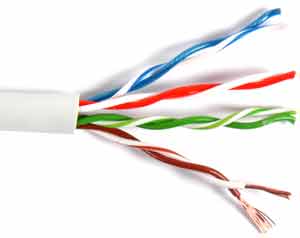
UTP
Most common type of transmission media for voice and data communications, connecting telephone company subscribers to the telephone central office (exchange) and computers in a local area network (LAN) such as Ethernet and Token Ring.
It consists of two 19 to 26 American wire gauge (AWG) thickness copper wires encased in color-coded plastic insulation, twisted around each other to minimize electromagnetic and radio-frequency interference induced from one wire to the other.
TP wires are categorized according to their thickness (thicker the better) such as CAT-3 for voice, CAT-4 for voice and 10-base-T, and CAT-5 for 100-base-T. Also called twisted pair (TP).
UTP cable is the most common cable used in computer networking. Modern Ethernet, the most common data networking standard, utilizes UTP cables. Twisted pair cabling is often used in data networks for short and medium length connections because of its relatively lower costs compared to optical fiber and coaxial cable.
UTP is normally used for LAN purpose only...

STP
It consists of two 19 to 26 American wire gauge (AWG) thickness copper wires encased in color-coded plastic insulation, twisted around each other to minimize electromagnetic and radio-frequency interference induced from one wire to the other.
TP wires are categorized according to their thickness (thicker the better) such as CAT-3 for voice, CAT-4 for voice and 10-base-T, and CAT-5 for 100-base-T. Also called twisted pair (TP).
UTP cable is the most common cable used in computer networking. Modern Ethernet, the most common data networking standard, utilizes UTP cables. Twisted pair cabling is often used in data networks for short and medium length connections because of its relatively lower costs compared to optical fiber and coaxial cable.
UTP is normally used for LAN purpose only...
STP
Transmission media used often where the cable must pass near sources of electromagnetic interference (noise), such as high-voltage power lines, motors, television, transformers, x-ray machines. It consists of several pairs of unshielded twisted wire enclosed in an outer shield of metal or metal-braid. This shield conducts ambient noise safely to the ground, and thus provides high quality signal transmission. See also coaxial cable.

CABLING
STRAIGHT CABLING
Different devices - Straight Cabling [Eg. Switch <-> PC]
color coding combination
white orange
orange
white green
blue
white blue
green
white brown
brown
CROSS CABLING
Cross cabling : Same device [Eg. PC <-> PC]
white orange - white green
orange - green
white green - white orange
blue - white brown
white blue - brown
green - orange
white brown - blue
brown - white blue
CABLING
STRAIGHT CABLING
Different devices - Straight Cabling [Eg. Switch <-> PC]
color coding combination
white orange
orange
white green
blue
white blue
green
white brown
brown
CROSS CABLING
Cross cabling : Same device [Eg. PC <-> PC]
white orange - white green
orange - green
white green - white orange
blue - white brown
white blue - brown
green - orange
white brown - blue
brown - white blue

Very informative and well written post! Quite interesting and nice topic chosen for the post.
ReplyDeleteLenovo - ThinkPad 15.6" Laptop - 4GB Memory - 500GB Hard Drive - Black (T530-2392ASU)
Lenovo - ThinkPad 15.6" Laptop - 4GB Memory - 180GB Solid State Drive - Black